Rottweiler obstacle training can add variety to your dog’s routine, but a backyard course should begin with confidence and control—not height or speed. A few simple foundation exercises are more useful than a collection of homemade obstacles your dog is not ready to use.
Adapt activities to your dog’s age, health and experience. If your Rottweiler has mobility problems, is recovering from an injury or is still growing, discuss suitable exercise with your veterinarian before adding demanding movements.
Start With Foundations, Especially for Puppies
A puppy can learn to pay attention, follow a hand target, wait briefly and move beside you without jumping. These skills remain useful if you later join an agility class. Reward small successes and finish before the dog becomes tired or frustrated.
Do not assume that jumping around at home makes repeated training jumps appropriate. The AKC’s puppy agility guidance distinguishes foundation learning from full-height jumps, contacts and closed weave poles. Ask your vet and a qualified instructor when your individual dog is ready to progress.
Choose a Safe Space
Use a secure area with enough clearance to approach and leave each activity. Check for holes, sharp edges, slippery ground and nearby objects a dog could collide with. Avoid training in uncomfortable heat and have water available.
Inspect equipment before every session. A household object is not automatically safe because it is inexpensive or looks similar to agility equipment. Wobbly furniture, projecting fasteners and surfaces that become slippery under paws do not belong in a training course.
Begin with one activity rather than linking everything into a fast circuit. You should be able to stop, reset and reward without rushing your dog toward the next obstacle.
Introduce a Tunnel Gradually
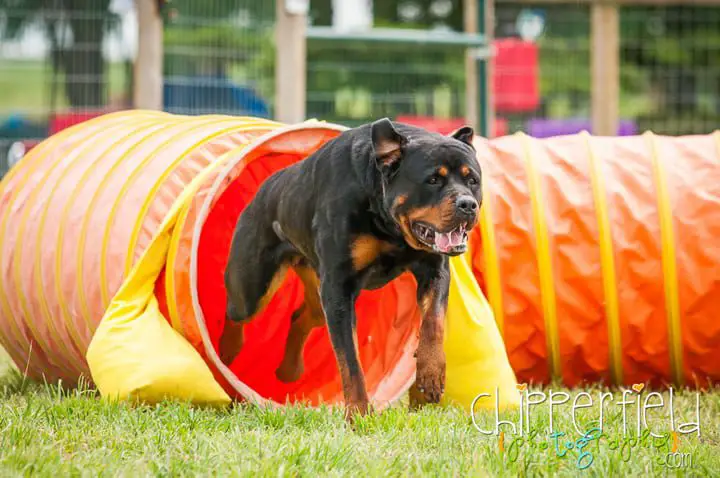
Choose equipment designed for dog training, appropriately sized and secured according to its instructions. A child’s play tunnel may not be suitable for a large, powerful dog. Check the opening, material and stability rather than judging by price alone.
Let your dog investigate without pressure. A short, straight, open tunnel is a simpler introduction than a long curved one. Reward willingness to approach and make the task easier if the dog hesitates. Do not push, drag or trap a dog inside.
If you are unsure how to secure or introduce the equipment, work with an instructor. There is no need to solve every training step through trial and error at home.
Use Wide, Gentle Turns Before Weaving
Walking a comfortable route around widely spaced cones can help you practice communication and direction changes. Keep the movement unhurried and avoid tight, repetitive turns. This is a foundation exercise, not a substitute for learning competition weave technique.
Closely spaced weave poles require more demanding movement. Do not introduce them to a growing puppy simply because you can build a set from pipes. Equipment spacing, technique and physical readiness deserve professional guidance.
Treat Jumps as a Later Step
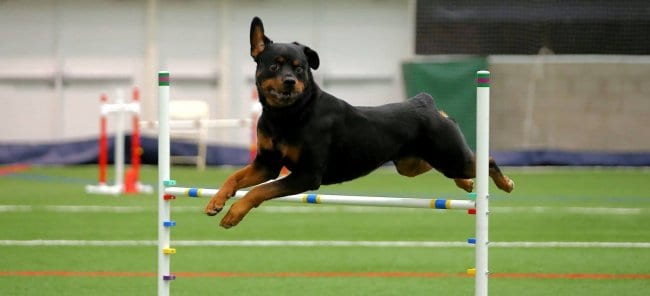
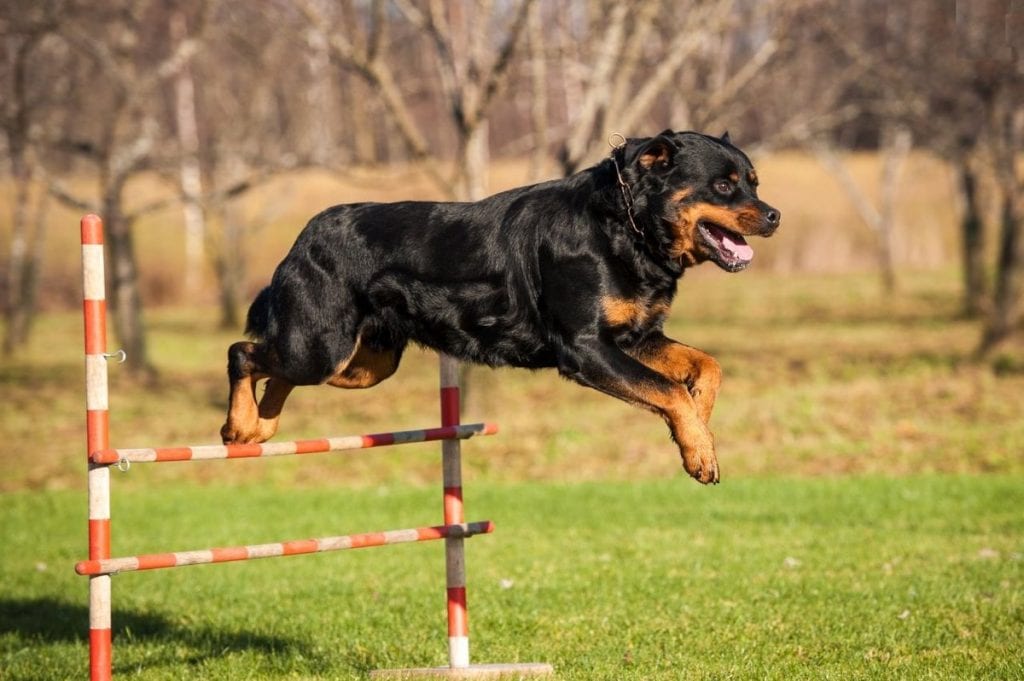
The jumping photograph illustrates an activity for a suitably prepared dog, not a starting target for a puppy. Begin with ground-level skills and progress only when appropriate. Do not keep raising a bar to see how high your dog can go.
Purpose-made equipment with a displaceable bar is preferable to fixed household barriers. Even suitable equipment needs a sensible setup and instruction. The AKC’s home agility introduction can help you identify foundation work to discuss with a trainer.
Keep Sessions Comfortable and Rewarding
Use short sessions, breaks and rewards your dog enjoys. Stop if movement changes, enthusiasm drops or the dog appears uncomfortable. Repeated refusals are a reason to reassess the task, not proof that the dog needs a firmer hand.
Build reliable basics with our home-training guide. For another low-pressure activity, see our gradual crate-training approach, which develops comfortable settling rather than physical exertion.
Your goal is a dog who understands the game and wants to participate. Formal agility lessons are the best next step when you want to move beyond simple foundations into equipment skills or competition.