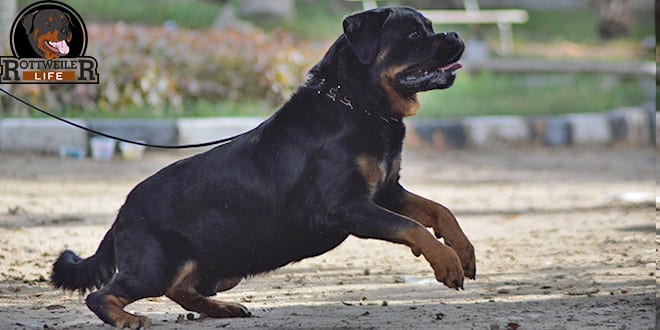
If your Rottweiler is the calmest dog ever at home, but then on walks he becomes aggressive and transforms into the canine personification of a Stephen King’s horror character, you may be desperately looking for some help.
First and foremost, take a deep breath and relax; you are not alone. Countless dogs become reactive when they’re out and about and exposed to people, other dogs and outdoor stimuli. The causes behind this behavior can be several, but it’s important to implement changes before the behavior gets out of hand.
If you think the behavior will solve on it’s own, think again; rottweiler aggressive behavior tends to worsen over time rather than get better. So roll up your sleeves and start working on the issue, and if need be, consult with a professional especially if your dog’s aggression makes you uncomfortable or if your dog poses a danger to you and others. Play it safe! Following are some tips to get you started.
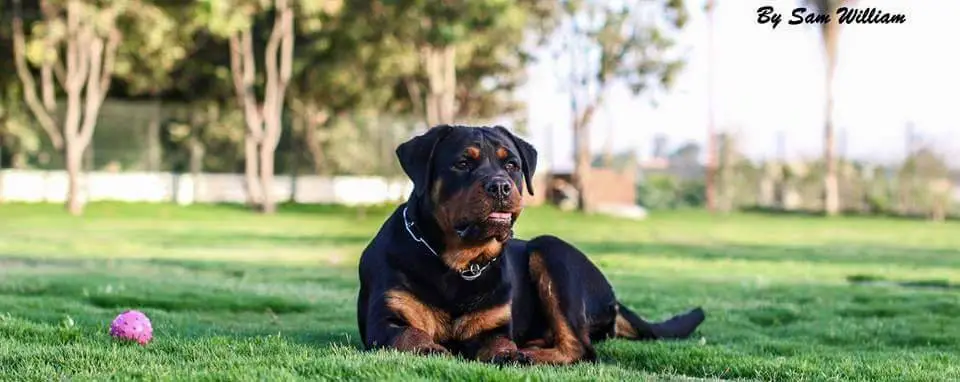
1 Start with a Medical Exam To avoid Rottweiler aggressive
Rottweiler aggressive behavior can sometimes be triggered by medical causes. The Rottweiler breed is prone to hypothyroidism, a medical condition that can sometimes cause dogs to develop personality changes. Any loss of hearing or changes in vision can also make your Rottweiler feel particularly vulnerable and more jumpy. Neurological problems may also cause aggressive behaviors. On top of that, Rottweilers are also prone to ear infections, and other other painful conditions such as achy joints and pinched nerves in the spine which can make them generally grumpy even on walks. Doesn’t hurt to give your Rottweiler the benefit of doubt and rule out medical problems first before assuming you’re dealing with a behavioral issue.
2 Understand Dog Aggression
Dog aggression is natural, instinctive behavior. Yes, it can be scary, yes, it may seem difficult to control, yes, it may look like it comes out of nowhere (to the untrained eye), but it’s a behavior linked to survival and ultimately meant to keep your dog safe. In many cases, your Rottweiler’s aggressive display is simply his way of asking for distance from something he perceives as threatening. Not surprisingly, fear is often a main cause of aggression. So just as you would stomp your feet loudly to scare off a snake, your Rottweiler may bark, growl and lunge to create distance and make the trigger go away.
3 Identify the Triggers
What upsets your Rottweiler? Most likely you already know what your Rottweiler reacts to, but it doesn’t hurt to compile a list if there are several triggers. Is it certain types of people? People wearing hats, sunglasses on bikes? Is it all dogs? Or only small, dogs, big dogs or dogs of a certain breed or color? Is it motorcycles, cars with a loud motor, trucks? Once you identify your Rottweiler’s triggers, you can takes steps to work on the issue through gradual, systematic exposure.
4 Practice Makes Perfect
Just as actors get better as they act, dogs get better at acting aggressive the more they rehearse the aggressive behavior. There are several explanations for this. First, consider that the aggressive display can be rewarding. If every time your Rottweiler barks at a person on a bike, and the person on the bike moves away, your Rottweiler thinks his barking behavior is what made the person on the bike move away.
The result? The barking behavior puts roots, increases and soon you’re stuck with a habit. On top of that, consider that aggressive behavior can be physiologically addicting. According to James O’ Heare, a certified dog behavior consultant, when your dog reacts out of anger or fear, several chemicals are released in the brain and this chemical bath can become addicting which also explains why rottweiler aggressive behavior tends to be so difficult to eradicate once established. Your best bet? Try your best to minimize your dog’s aggressive displays, which brings us to the next tip.
5 Manage the Environment
To prevent your Rottweiler from rehearsing the aggressive behavior, try to limit his exposure to triggers when you’re not working on the problem. This means, if your Rottweiler is reactive towards other dogs, walk him when there are less around, if he hates cars walk him on a quiet country road, if he barks at people, walk him in the wee hours of the morning when most are sleeping. And if you’re walking and you notice a trigger coming your way, make a sudden U-turn and walk the other way. Of course, avoidance won’t fix the problem, but it can help it from getting worse, and if you’re worried about getting nowhere when you manage your dog’s environment, remember that it’s just a temporary measure when you’re not working on the issue.
6 Invest in a No-Pull Harness
It may scary at times dealing with a large Rottweiler that pulls with all his might as he barks and growls. A no-pull harness, also known as front-attaching harness can help make a difference. The harness controls the dog’s shoulders and since the leash attaches to a ring in the front of the chest, in the worse case scenario should your Rottweiler pull, the harness will turn him sideways. Another option is a head halter, which controls the dog’s head just like halters on horses; however, some dogs aren’t very fond of these and it may take some time to adjust.
7 Work Under Threshold
Whether your Rottweiler is reactive towards other dogs, people or kids on roller blades, you may have noticed how it’s almost impossible to get his attention when he’s dealing with these stimuli. Why is that? Most likely, your Rottweiler is over threshold. What does it mean? No worries, it’s not a new disease. It simply means he’s too worried to use his brain, and therefore, there’s little space for learning to occur.
After all, if you are afraid of heights, would you be able to solve a math problem from the top of a sky scraper? Most likely not because of the adrenaline surge! In the same way, your Rottweiler can’t concentrate because he’s in fight or flight situation. As much as this sounds like bad news, the good news is that you can often lower that threshold by increasing distance. The goal therefore is finding a distance from which your Rottweiler acknowledges the trigger, but without it evoking an aggressive reaction. This will help desensitize him to the trigger. If he reacts at any time, remember to take a few steps back and increase distance. Here’s another tip: if your dog is under-exercised he’ll be more likely to be reactive, so make sure to drain all that pent-up energy!
8 Add Classical Counter-conditioning
Don’t let this word scare you. It sounds a tad bit complicated, but it simply means changing your dog’s emotional response towards a trigger. Classical counter-conditioning is used in human psychology, but it’s heavily used by dog behaviorists too. Once you have found a distance from which your dog is less worried about the trigger, feed high-value treats. Skip kibble or cookies. You want small, bite sized treats that your Rottweiler will do somersaults for. The smellier, the better. If your Rottweiler won’t eat high-value treats, either they’re not high-value enough, or he’s lost his appetite because he’s too close to the trigger—give more distance! A wonderful exercise coined by dog trainer Leslie McDevitt, is the “Look at That” exercise. Basically, every time your dog looks at the trigger, he’s fed high-value treats. Then, once the trigger is out of sight, no more treats.
If you were terrified of spiders, how would you feel if every time you spotted one, you got a $100 dollar bill? Most likely, you would start loving those eight-legged fellows! If you have good timing and repeat enough, your Rottweiler should realize that the trigger has become a predictor of good things, so from dreading the trigger he may start looking forward to seeing it. You may therefore notice a more relaxed posture, and even a hint of a tail wag! At this point, you can try getting a bit closer, but go very gradually, if you over do it, you risk losing some progress!
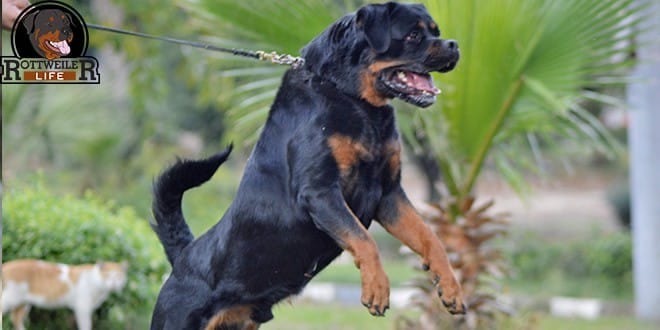
9 Shift to Operand Counter conditioning to avoid Rottweiler aggressive
It may take some time, but at some point, your Rottweiler should be getting better being around the trigger because it has now become a predictor of good things. Dr. Sophia Yin, the late world-wide known veterinarian and animal behaviorist, suggested implementing operand counter conditioning once the dog’s emotions towards the trigger changes. Since now your Rottweiler is no longer upset and his brain is back to working, you can start asking him for a sit the moment he notices the trigger and reward him for sitting with high-value treats. You want your Rottweiler thinking “cool, every time I see the trigger, I sit and get rewards!” With this method, your Rottweiler still makes some positive associations that change his emotions for the better, but now he also learns to perform an alternate behavior that replaces the aggressive lunging, a win-win situation for all!
10 Consult with a Pro
Behavior modification for aggression in dogs comes with some risks. If your Rottweiler aggressive on walks, your best bet is consulting with a dog behavior professional. Sloppy implementation of behavior modification may not bring results as hoped. A behavior professional can help you recognize subtle stress signals in dogs so you can prevent your Rottweiler from going over threshold. And remember to find a professional who employs gentle techniques; it’s proven that harsh methods based on intimidation or punishment-based tools can exacerbate aggression and produce adverse effects!