
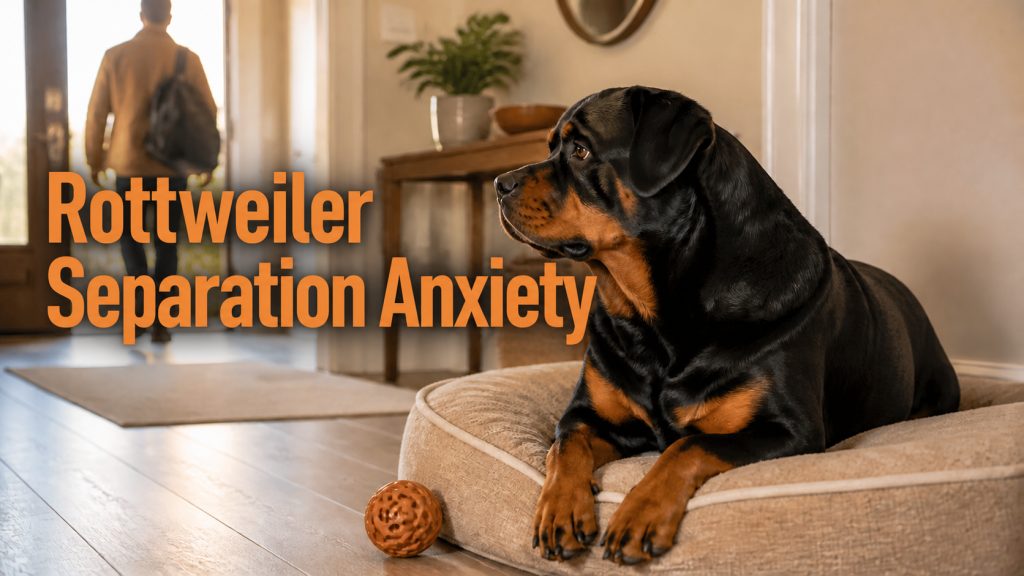
Rottweilers are devoted dogs that often form exceptionally close bonds with their families. That loyalty is one of the breed’s greatest qualities, but it can also make time alone difficult for some dogs. A Rottweiler with separation anxiety is not being stubborn, dramatic, or “getting revenge.” The dog is experiencing genuine distress when a particular person leaves or when the home becomes empty.
The good news is that separation-related problems can improve. Progress usually comes from identifying the dog’s triggers, preventing overwhelming absences, building independence in small steps, and working with a veterinarian or qualified behavior professional when the anxiety is severe. This guide explains what owners should watch for and how to create a humane training plan that moves at the dog’s pace.
What Is Rottweiler Separation Anxiety?
Separation anxiety is a panic-related response connected to being apart from an attachment figure. It is different from ordinary boredom. A bored dog may chew an available object or look for entertainment after being alone for a while. A dog with separation anxiety often becomes distressed shortly before departure or within the first minutes after the owner leaves.
Not every Rottweiler that follows its owner from room to room has anxiety. Many Rottweilers are naturally social and attentive. The important question is whether the dog can remain emotionally settled when separated. A relaxed dog may nap, change resting places, drink water, or calmly use a food toy. An anxious dog may be unable to eat, rest, or disengage from the exit.
Common Signs of Separation Anxiety in Rottweilers
Symptoms vary, and owners sometimes discover them only after a neighbor complains or a camera records the dog. Signs commonly associated with separation distress include:
- Persistent barking, whining, or howling after departure
- Pacing in repeated paths or circling near doors and windows
- Scratching, chewing, or pushing at exit points
- Heavy panting, drooling, trembling, or restless scanning
- Refusing a favorite treat when left alone
- Indoor urination or defecation despite reliable house training
- Trying to escape a crate, room, or house
- Following the owner constantly and becoming agitated during departure cues
- Overwhelming greetings that take a long time to settle
Destruction focused around doors, window frames, or barriers deserves special attention. A powerful Rottweiler can injure teeth, nails, or paws while trying to escape. If your dog is hurting itself, breaking through barriers, or showing intense panic, contact your veterinarian promptly rather than waiting to see whether the problem disappears.
Why Does Separation Anxiety Develop?
There is rarely one simple cause. Genetics, temperament, learning history, health, and changes in routine can all play a role. Some dogs struggle after adoption or rehoming. Others develop problems after a family member returns to work, a household moves, another pet dies, or the dog experiences a frightening event while alone.
A sudden behavior change can also have a medical component. Pain, gastrointestinal problems, urinary disease, age-related cognitive changes, and other health issues may make solitude harder. That is why a veterinary examination is an important first step, especially when symptoms begin abruptly or appear in an older dog.
Owners do not cause separation anxiety simply by loving their dogs, allowing them on furniture, or letting them sleep nearby. Affection is not the problem. The goal is to help the dog feel safe and capable when people are absent, not to weaken the relationship.
First, Confirm What Happens When You Leave
A simple home camera is one of the most useful tools for this problem. Record several ordinary departures and note when the first sign of stress appears. Does your Rottweiler react when you pick up keys, when the door closes, or ten minutes later? Can the dog eat? Does the distress continue, or does it settle?
Video also helps separate anxiety from other issues. Barking at people outside, reacting to delivery vehicles, chewing from boredom, and distress caused by confinement can look similar from the evidence left behind. Training becomes much more effective when it targets the actual trigger.
A Step-by-Step Rottweiler Separation Anxiety Training Plan
Step 1: Prevent Full-Panic Absences When Possible
Every overwhelming episode rehearses the fear. During the early training period, arrange the schedule so your dog is not repeatedly left longer than it can handle. Depending on the household, this may involve a trusted relative, pet sitter, dog walker, dog-friendly workplace, or carefully selected daycare. Daycare is not suitable for every dog, so consider temperament and the quality of supervision.
This management stage is not the final solution. It creates enough emotional stability for learning to occur.
Step 2: Establish a Predictable Daily Routine
Provide regular meals, toilet breaks, age-appropriate exercise, rest, and short training sessions. Rottweilers benefit from both physical activity and mental work, but exhausting a frightened dog is not a cure. A balanced walk with time to sniff, followed by a calm settling period, is usually more helpful than intense activity immediately before departure.
If you need ideas for safe routines, review our Rottweiler training guides. Puppies, seniors, and dogs with orthopedic problems need exercise plans suited to their bodies.
Step 3: Teach Relaxation While You Are Home
Begin on a quiet day. Reward your Rottweiler for resting on a bed or mat while you sit nearby. Gradually stand up, take one step away, return, and reward calm behavior. Over multiple sessions, increase distance and move briefly out of sight.
Keep sessions short enough that the dog succeeds. You are teaching that distance is ordinary and temporary. A dog that cannot relax while you walk to another room is not ready for a long absence outside the house.
Step 4: Make Departure Cues Less Predictive
Keys, shoes, a work bag, or a particular jacket can trigger anxiety before the owner reaches the door. Practice these cues at times when you are not leaving. Pick up the keys and put them down. Put on your shoes, prepare a drink, and remain home. Open and close the door without departing.
Use calm repetitions rather than performing every cue repeatedly in one session. The purpose is to loosen the connection between the cue and a frightening absence, not to keep the dog on alert all day.
Step 5: Begin Very Short Departures
Start below your dog’s anxiety threshold. For one dog, that may mean touching the door handle. For another, it may mean stepping outside for three seconds. Return before pacing, vocalizing, panting, or frantic movement begins.
Repeat a manageable duration several times, mixing in easier repetitions. Increase time gradually and avoid making every absence longer than the previous one. Real progress is rarely linear. If your dog shows stress, shorten the next repetition. A camera allows you to return based on the dog’s behavior rather than guesswork.
Step 6: Add Enrichment Carefully
A stuffed food toy, safe chew, or scatter of food can help a dog that is mildly concerned and still able to eat. Introduce the item while you are home so you know the dog uses it safely. If your Rottweiler ignores favorite food as soon as you leave, the dog is probably too anxious for enrichment to solve the problem. Shorten the absence instead of offering increasingly valuable food.
Never leave a dog unattended with an object it may break, swallow, or guard. Choose products appropriate for a Rottweiler’s size and chewing strength.
Step 7: Increase Duration Without Rushing
Once short absences are calm, build duration in small, varied increments. A session might include 20 seconds, 10 seconds, 25 seconds, and 15 seconds rather than a constant climb. End while the dog is successful.
Keep a written log of duration, body language, food use, and recovery. The log reveals patterns that memory misses and makes it easier to notice small improvements. If progress stalls, return to an easier level for several sessions.
Should You Use a Crate?
A crate can be a comfortable resting place for a dog that already enjoys it. It is not a treatment for separation anxiety. Dogs that panic when confined may become more distressed and can seriously injure themselves trying to escape. Do not force an anxious Rottweiler into a crate or leave one crated for long periods in the hope that it will “get used to it.”
Use camera evidence to compare safe options such as a dog-proofed room, gated area, or free access to an appropriate part of the home. Choose the setup in which the dog is safest and most relaxed.
What Not to Do
- Do not punish the aftermath. The dog cannot connect punishment at your return with behavior that occurred earlier.
- Do not use shock, spray, or harsh anti-bark devices. Suppressing noise does not resolve panic and may increase fear.
- Do not force the dog to endure a long absence. Flooding can worsen the emotional response.
- Do not make dramatic departures. Calm, ordinary exits make the routine easier to understand.
- Do not assume another dog will fix it. Separation anxiety is often about absence from a person, and a second pet may not help.
Reward-based training is particularly important with a large, sensitive, intelligent breed. Our guide to Rottweiler characteristics offers more context on the breed’s temperament and need for thoughtful handling.
When Professional Help Is Needed
Seek qualified help if your Rottweiler self-injures, cannot tolerate even a few seconds alone, stops eating, has repeated toilet accidents, damages exits, or shows no improvement with a careful plan. Start with your veterinarian to rule out medical problems. The veterinarian may recommend a credentialed veterinary behaviorist or an experienced reward-based separation anxiety professional.
For moderate or severe cases, medication may be part of a complete treatment plan. Properly prescribed medication is not a shortcut or a failure. It can reduce panic enough for the dog to learn from gradual training. Medication decisions should always be made with a veterinarian, and owners should follow the prescribed dose and monitoring instructions.
How Long Does Recovery Take?
There is no reliable universal timetable. Some dogs with mild distress improve within weeks, while severe cases may require months of careful work. Changes in schedule, illness, travel, or a frightening event can temporarily cause setbacks. Judge progress by the dog’s body language and ability to remain relaxed, not by a deadline.
Consistency matters more than speed. A collection of calm, successful absences builds confidence. Repeatedly pushing beyond the dog’s limit usually slows the process.
Frequently Asked Questions
Are Rottweilers naturally prone to separation anxiety?
Rottweilers are people-oriented and often form close attachments, but not every Rottweiler develops separation anxiety. Individual temperament, early experiences, health, environment, and routine all influence how a dog handles time alone.
Can exercise cure separation anxiety?
Appropriate exercise supports physical and emotional health, but it does not cure panic. Exercise works best as one part of a plan that includes management, gradual departures, relaxation training, and professional care when needed.
Should I ignore my Rottweiler before leaving and after returning?
You do not need to withhold affection. Keep departures and greetings calm enough that they do not increase arousal. Once your dog can respond and settle, quiet attention is fine.
Can a puppy be taught to enjoy being alone?
Yes. Begin with very short, safe periods while the puppy is relaxed and gradually build duration. Meet the puppy’s toilet, exercise, social, and sleep needs first. Young puppies cannot be expected to remain alone for an adult dog’s schedule.
Final Thoughts
Rottweiler separation anxiety should be treated as an emotional and behavioral health issue, not disobedience. Observe what your dog does, rule out medical causes, prevent repeated panic when possible, and practice absences that remain below the dog’s threshold. With patient training and the right professional support, many Rottweilers learn that being alone is safe and that their people always return.
Continue building a healthy routine with our Rottweiler care and health resources, and remember that urgent or severe behavioral changes deserve veterinary attention.