Yeah, you got it right! Today, we are going to discuss about the strength of Rottweiler bite force. If we count in medical terms, Per Square Inch or PSI is the scientific unit that is primarily used to measure the force that a dog puts before it gives a bite. Although Rottweilers are lovely dogs, they are known to have one of the most powerful bite forces among all other pets in the world.
What do you mean by a bite force? How is it calculated?
A bite force of a dog is simply the power with which a dog puts its jaw on someone or something. PSI is basically a unit that calculates the released upon ant certain point. It is used to measure the pressure applied over one inch of a pound, and is also titled as “pound per square inch” or “pound-force per square inch.”
Why do some dogs have such strong bite forces?
Upon general consideration, it has been observed that a dog’s bite force generally depends on the size of its entire body. Its shape, dimensions of the jaw and skull seem to play a vital role in determining the bite force. It is observed that the bigger the dog breed, the stronger is its bite force.
Hence, one can say that the bite force of a dog is directly proportional to its body size. Well, even though Rottweilers are not so bulky, they still tend to have one of the strongest bite forces among other breeds of dogs with similar sizes.
Fact about Rottweiler bite force

If we count the origin of Rottweilers, we would know that they were originally bred to assist in labor works such as that of pulling carts, and in security tasks such as guarding the homes. They were commonly used by the police forces and are of great help to the security personnel.
These dogs, though moderate in size, comes with a great body stature and are known to have an astounding amount of power. They are quite nimble and own a good amount of endurance as well. Such a background makes this breed a perfect mix of strength, endurance and intellect, all packed in itself.
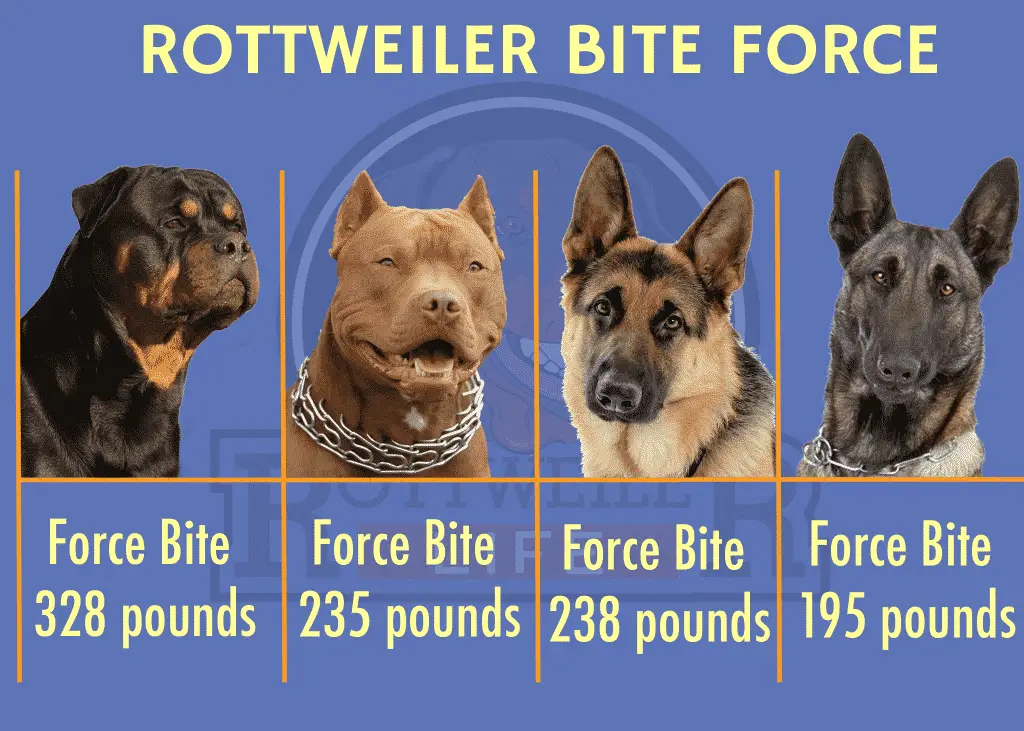
Well, Rottweilers have a bite force of approximately 300 pounds. This bite force can be calculated as 328 PSI, which is around twice of its own weight. Also, the Rottweilers are known to have the second strongest locking bite.
Rottweilers are good-natured, and have extremely humble behavior, but when threatened with risk, this breed will go in a self-defense motif within just a few seconds. It remains alert all the while, and thus, you need to make sure that you aren’t doing anything to trigger it into a protection style.
Comparing Rottweiler’s bite force with other dog breeds’ bite force
When we say that Rottweilers have a bite force of 328 PSI, here are some other dogs that have bite forces near to that of Rottweiler’s!
While Labrador retriever has a bite force of 230 PSI, American Pit bull bite force is 235 PSI, Doberman has a bite force of 245 PSI and Siberian husky has a bite force of 320 PSI. The German Shepherd has a bite of 238 PSI and American Bulldog has a bite force of 305 PSI. Hence, Rottweilers have quite strong bite force as compared to other dogs who are known to have strongest bite forces. Rottweilers, are thus, known to have the most effective bite force when compared to dog breeds like German shepherd and Pitbull that are often domesticated.
Factors determining the bite force of a rottweiler
It is important to note that even if we talk about PSI, Rottweilers do not bite with the same force all the time. They would probably exert a greater pressure when they are provoked or feel endangered. There is a high chance that a Rottweiler’s bite will be much harder in case they are in a defense mode and are barking, snarling or growling than that when it is just spooked and snaps faster.
How to control your rottweiler from biting?
If you do not want your rottweiler dog to bite, you should train him appropriately right from when it is young. Starting its training at an early age will help your Rottweiler to behave properly, and help you to teach your dog about not to misbehave in front of the guests or make you feel embarrassed all the way.
Also, a scheduled training will assist you to teach your dog about perceiving your intentions in a better way, so that it doesn’t end up misinterpreting the things all over again. It is important to make sure that you start training about these small things when it’s still young so that it doesn’t find any difficulty dealing with these habits later on.
Wrapping up:
It is important to know that each and every animal on this earth can keep harm one in some or the other way. The same goes for Rottweilers as well. However, we would better advise you to do a bit of research in order to make sure whether or not you would want to keep a rottweiler as your pet. It all depends on the understanding between you and your pet, and most importantly the kind of relationship you have!